
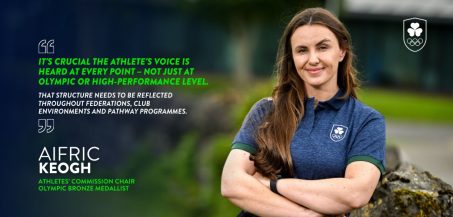
After two Olympic cycles and a medal-winning career, Aifric Keogh is taking on a different challenge – ensuring athletes have a stronger voice in Irish sport.
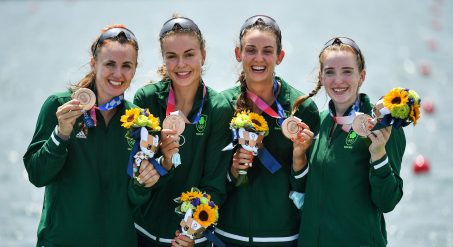
Keogh returned from Tokyo with a bronze medal and, as a passionate supporter of her Team Ireland colleagues across all Olympic sports, felt a strong desire to give something back.
Although interested in serving on the OFI’s Athletes’ Commission, the timing wasn’t right. The Galwegian had just started a course at Trinity College and decided to row on through the next Olympic cycle, aware from speaking to former commission members of the significant commitment involved.
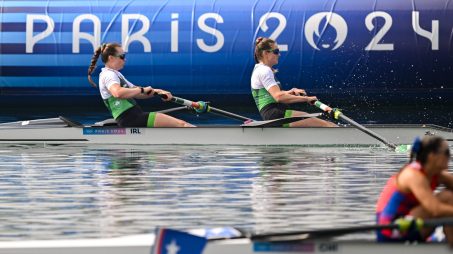
She stepped away from the rowers’ full-time set-up after Paris. Ask Keogh now if she misses rowing and she’ll say it depends on the day, but what she misses most is the team environment. The 33-year-old remains in constant contact with the lifelong friends she made through the sport.
“I have rose-tinted glasses looking back, but I know if someone asked me to go down and do a day’s training, I wouldn’t be as enthusiastic,”
Keogh laughed.
Previously, training accounted for 70 per cent of her week. Now working full-time, she was ready for a new challenge and, in April of last year, was elected by her fellow Athletes’ Commission members as chair of the OFI’s Athletes’ Commission for the LA cycle.
“It was a great opportunity to stay involved and to see what it’s like behind the scenes – to see what working in sport might look like,”
she reflected.
Taking on a leadership role did not come naturally to Keogh, but, coming from a sport where teamwork was crucial, she was determined to carry that ethos into her new position.
“It was always about the group rather than the individual,”
she said.
“Everyone has elements of leadership in what they do. One thing we used to say was: ‘It’s your turn to drive the train today.’ It’s kind of the same here.”
Delegation proved crucial during the board’s infancy. The first six months were a “bit of a whirlwind”, Keogh recalled. The new members were only getting their feet under the table when the calls started coming in.
“We’ve found athletes are reaching out,”
Keogh added.
“In times of uncertainty, stress or tension, they know they can turn to us.
“We don’t have the answer for everything, and we don’t have the power to step in and make decisions. But we can be that critical friend – someone who’s lived it before and might have some advice to pass on.”
Part of the challenge became apparent almost immediately. Many of the congratulatory messages Keogh received following her election were accompanied by the same question: what does the role involve?
Visibility and awareness form one strand of a newly published Athletes’ Commission strategy plan devised by the group, with the assistance of Studio Saol.
“We want athletes to know we’re here if they need us,”
Keogh stressed.
“We can potentially speak on their behalf. Or, if they just want to have a quiet word about something, they can pick up the phone.”


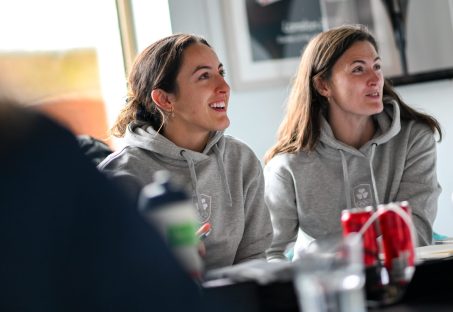
Each commission member has taken responsibility for two or three sports, making themselves available to those athletes. A new digital hub is being developed to host commission seminars and additional resources – a space athletes can access in their own time.
An Instagram page has also been launched. While the commission remains under the Team Ireland umbrella, Keogh and her colleagues were keen to establish a distinct and recognisable brand to improve visibility.
The Athletes’ Commission acts as a bridge between those who govern sport and those who live it. As a member of the OFI board, Keogh is able to bring the athletes’ perspective directly to the table.
She believes athletes must be involved in decision-making at every level of the pathway –from grassroots to high performance – particularly when choices are being made around preparation and competition.
This forms the second strand of the new strategy: a mirror-like structure that places athlete representatives within every sport, feeding into their respective boards and ensuring that engagement filters down through the system.
“People get involved in sport because they love it and want what’s best for athletes,”
Keogh said.
“But how are you supposed to know that unless you actually speak to them?
“It’s crucial the athlete’s voice is heard at every point – not just at Olympic or high-performance level. That structure needs to be reflected throughout federations, club environments and pathway programmes.”
Keogh has seen first-hand how athlete representation operates at the highest level. The International Olympic Committee has its own Athletes’ Commission, made up of competitors from across the globe, with representation at board level. The current President of the IOC is a former Chair of the IOC Athletes’ Commission.
Her ambition is for Ireland to follow that model, recognising the importance of a clear feedback loop and strong communication.
“If that happens, I think a lot of problems could potentially go away,”
she said.
“I know myself, if you hear about a major change six months down the line — whether it’s half-baked or about to be implemented — it can be frustrating. You end up asking: ‘Did anyone ask us if this is what we want, or what’s best for us?’
“Even when intentions are good, failing to involve athletes can create gaps in communication that lead to tension and frustration.”
Keogh believes early engagement is key to preventing issues before they arise.
“If athletes are involved from the start, you may avoid those moments that often crop up later. It’s about prevention rather than stepping in at the last minute to fix something.
“We have ambitious plans, and whether we achieve all of them remains to be seen. But it’s about having a clear wish list and allowing the next group to decide whether they want to build on what’s already there.”
The commission was initially established as a consultative forum but its role evolved into a structured partnership between athletes and the OFI.
Those serving do so voluntarily, and Keogh acknowledged the challenges faced by previous members, many of whom were either competing full-time or juggling employment alongside the role.
There is a clear determination among the current commission to put structures in place that will endure.
“One thing we asked was: what do we want this to look like in eight or 12 years?”
she explained.
“We focused on best practice – what it should look like in our view – but also what we can realistically do now to impact current athletes and the existing system, while setting up the next cohort for success.
“The feedback was that change takes time. So we looked at what we could do to speed up that process and make things easier for those who come after us.”