

TWELVE months ago, wallowing in the emotional floodplain post-Paris 2024, Fiona Murtagh wanted to quit rowing.
Eighth place in a pair that failed to make the Olympic final in Paris 2024, and that brilliant bronze medal with the coxless four in Tokyo in 2021 seemed a fading memory.
Many of those who’d soldiered alongside her in the sweep boats at national rowing HQ in Inniscarra were drifting away and coaches had changed too. Suddenly she found herself at a crossroads.
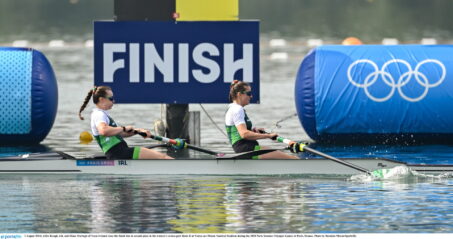
Enter Dominic Casey, the godfather of reinvention, who wouldn’t take no for an answer, insisting she should add another oar to her hands and remodel herself as a single sculler.
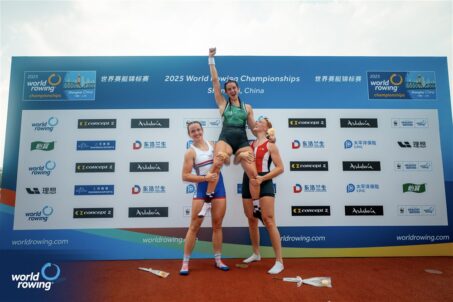
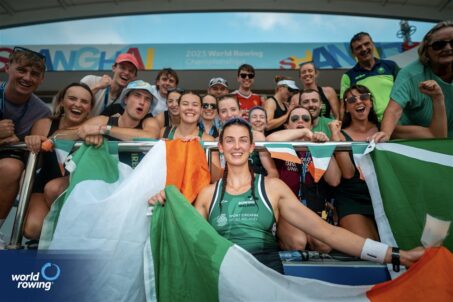
Now she is the world champion, still pinching herself at her extraordinary victory, by just three hundredths of a second, at the 2025 World Championships in Shanghai and looking forward to LA 2028.
Rollercoaster doesn’t remotely capture Murtagh’s remarkable year.
Casey’s faith first showed dividends with a silver at Europeans in June but six weeks later the Moycullen powerhouse capsized 400m from the line at National Championships and had to be dramatically rescued.
She bounced back immediately, stroking the University of Galway to victory in the eights and was well up for the slagging on the banks, quipping “sure I’m only a novice sculler!”
Pulling a single scull, compared to a crew boat, feels like riding a flighty thoroughbred, liable to tip over at any sudden movement. It has been a terrifying learning curve at times especially on choppy water.
“Honest to God, those Europeans were so windy that it was borderline fear for the whole week.
“I was outside my comfort zone all year really but my exposure to severe wind was particularly low because, if it was windy here, I used to avoid it and train on land.”
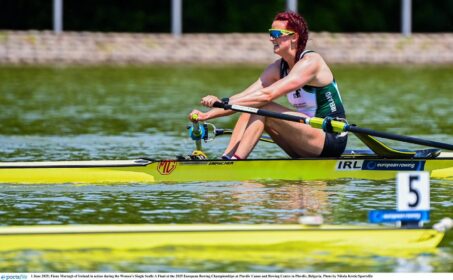
Yet her body’s ability to adapt has surprised even Murtagh, who turned 30 in July.
“I’d been sweep rowing for 15 years or more and used to have certain back issues, hip pains and weakness through my thoracic (spine) from rotating.
“I’m using both arms very evenly now, smack in the middle and I have this symmetry that I didn’t have for years. It’s kind of straightened me out and fixed my spine a little bit which is funny.
“How I row now is also very different. Sweep boats are more back-end focussed and my drive sequence now is quite different and I’m actually doing way less volume in training.
“I’m doing it all on my own so it taker longer. The single moves slower than any other boat so my volume is down but time-wise I’m not that far off what I used to do.”
That’s still four hours training a-day, six days a-week and somehow Murtagh has managed to become world champion in a new discipline in one season while returning to the work-force in February.
Her degree from Fordham University was in science. She has an MBA from Galway and is working full hours as an intern with JP Morgan in Cork City.
“It’s not for everyone. I train early mornings, do weights or a run at lunch-time and am back on the water in the evenings after work but the office is in Penrose Quay, I can train at Cork Rowing Club which is very close and my employers have been fantastically flexible whenever I’ve needed it.”
The autonomy of becoming a single sculler actually helps logistically.
“The fact that I’m not co-ordinating training with two or four others makes it easier to fit it in around work and I put more emphasis on my weekends to take the pressure off during the work week.
“It might seem like it’s me on my own now but it takes a village, honestly. I’ve only been able to do this with the support of a lot of people in work and Rowing Ireland and especially Dominic. He has been amazing at finding solutions to everything. There’s never been a moment of ‘we can’t do this.’ It’s always been ‘how can we fit it in?’”
Murtagh may have agreed, in her post-Paris funk, to try the single as “a place of convenience” but it has become a showcase for her singular talent and adaptability.
“Sometimes a change can be as good as a rest, especially in a post-Olympic year. For me sculling was something new entirely. It didn’t feel like training for a lot of the year because I was learning a completely new skill set. At times going to regattas felt like a holiday compared to the training and I’m still learning, which is incredibly exciting.
“I’ve had moments of sculling before but always ended up getting injured or didn’t enjoy it. I never gave it the time because I thought I wasn’t good at it but now that I’ve given it my full attention I’ve thrived.”
So what is this extraordinary gift that Dominic Casey – the man behind Skibbereen’s medal factory and now Rowing Ireland’s head coach – has for detecting and burnishing potential?
“He definitely sees things in people that they don’t see in themselves and just gives you this confidence. When he suggested it initially I thought he was messing,” she admits.
“But he is very reassuring while being equally firm. It’s hilarious. There’s just no way you can refuse Dominic.”
No one in Irish sport has conquered a steeper learning curve in 2025 than Murtagh. “Yeah, I’ve experienced everything you possibly could; highs, lows, that flip at Nationals and then the World Championship. It’s been mad but brilliant,” she laughs.
And she is particularly delighted to follow in the wake of Sanita Puspure, the back-to-back world single sculls champion in 2018-19 who did so much to put Irish rowing on the map.
“She trains at Cork Boat Club as well. I’ve seen her often over the year and she’s been great. As a kid growing up Sanita was Ireland’s single sculler and what she achieved in her career is phenomenal.
“Whenever I look at a yellow Empacher I will always think of Sanita. To think that people will see a yellow sculling boat now and think of me, that’s hard to believe and such a huge honour.”