

‘Fintan and Paul have got to live the wars that I haven’t even got to see the start of yet’
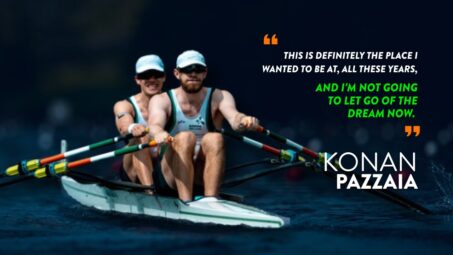
It was only nine years ago, as a teenager glued to watching the 2016 Olympic Games in his home in France, that rowing first caught Konan Pazzaia’s imagination.
His surname is Italian (from his grandfather) but his mother hails from Belfast. At the time he specialised in table-tennis and dabbled in rock climbing but spotting two Irish rowers – Paul and Gary O’Donovan – winning a historic Olympic silver in Rio immediately caught his attention.
His family moved across the border to the shores of Lake Geneva not long afterwards and, unable to find a strong table-tennis club, he took up rowing.
Hooked from the very first session
He was “hooked from the very first session” yet, despite representing Switzerland in a four at Coupe de la Jeunesse (underage level), still regarded it as a hobby.
Then, in another sliding door moment, while visiting his grandparents in Belfast in early 2020, his potential was spotted and harnessed for Ireland.
“I did a few sessions at Belfast Boat Club and John Armstrong gave me his contact and said ‘if you’re about here again send me an email.’”
After finishing school and with COVID restrictions lifted, he spent the summer in Belfast ahead of five months’ military service, which is compulsory in Switzerland.
His rowing impressed enough to earn a scholarship offer at Queens University (where he is now studying Human Biology) and a call-up from Rowing Ireland.
With the lightweight category now removed from the Olympic schedule, double Olympic lightweight sculls champions (LM2x) Fintan McCarthy and Paul O’Donovan now have to transition to heavyweights.
Pazzaia was already among Ireland’s heavyweight squad and is currently preparing for the national trial to decide crews for next month’s World Rowing Championships in Shanghai (September 21-28)
So how did the 24-year-old suddenly find himself successfully partnering McCarthy to a European M2x bronze medal this year and another bronze at the Lucerne World Cup?
Pazzaia was already a World U23 BM2x champion with Brian Colsh in 2023 but admits even he was shocked to make such an unexpected leap.
“I was still studying for exams when the trial for Europeans took place back in April and kind of surprised at what speeds I was throwing in the singles.
“That got me into the doubles matrix and then it turned out Fintan and I were the quickest out of all the combinations that were tried. That was just a month before Europeans so I wasn’t really expecting it to go that well,” he admits.
He credits some of it to a complete re-set after the last Olympic cycle when he was the ‘spare’ for the bronze-winning men’s double in Paris.
“I wasn’t an Olympian. I didn’t have the accreditation saying I was an athlete. I wasn’t in the village. I was on the sidelines, like a support crew, until competition started.”
While delighted for Philip Doyle and Daire Lynch, Paris 2024 proved a somewhat bitter-sweet experience.
“Afterwards I was kind of like, I’m going to heal my relationship with rowing and start from scratch and build the pillars for the next cycle. I always felt LA (2028) was the main goal for me.”
Getting to partner McCarthy then turbo-charged his progress.
“It’s not every day you get to row with an Olympic champion. That’s something you’d dream of as a kid and I’m in a boat with someone who has done that not once but twice. I knew from the get-go that I was going to be learning every single day with Fintan, and I was right.
“Dominic (Casey, now Rowing Irelands’ High Performance Lead Coach) was managing the lightweights before, so I wasn’t involved in the sort of training they were doing and adapting to that was a big step for me.
“Fintan’s also got a degree in physiology. He knows so much about training zones, energy usage and training load. He’s taught me how to train and row efficiently. I was just thrown into a whole different world physiologically, learning every day.”
It brought pressure but also a massive boost, especially some early feedback from McCarthy which Pazzaia, initially, didn’t believe.
“At the end of the (national) trial Fintan said ‘that was class!’ I thought he was joking or just trying to make me feel good when he said it felt really good in the warm-up and in the paddle before the race. Then afterwards, realising he was serious, that really meant a lot.”
Pazzaia says that for Ireland’s brilliant lightweights to make the switch to heavyweight is not the big leap physically that some imagine.
“For a long time people looked at who had the fastest 2km or looked at the numbers on a rowing machine or the best lactate scores but rowing, like cycling, is all about power-to- weight ratio now.
“Before Fintan and Paul mightn’t have pushed the same watts as we might on land but as soon as they were on the water they would be going quicker. They have always had a really, really good power-to-weight ratio. They’re probably still quite light for the power they can put out.
“Before Europeans and the World Cups I was doing just shy of 300km and Fintan was doing even more than that. We were training fairly hard but rowing also takes huge mental strength and commitment. You have to be fully there physiologically and psychologically as well.
“Fintan and Paul have so much experience. They’ve got to live the wars that I haven’t got to even see the start of yet so I’m really lucky to have been in with Fintan and this was a big, big step for me.
“This is definitely the place I wanted to be at, all these years, and I’m not going to let go of the dream now.”